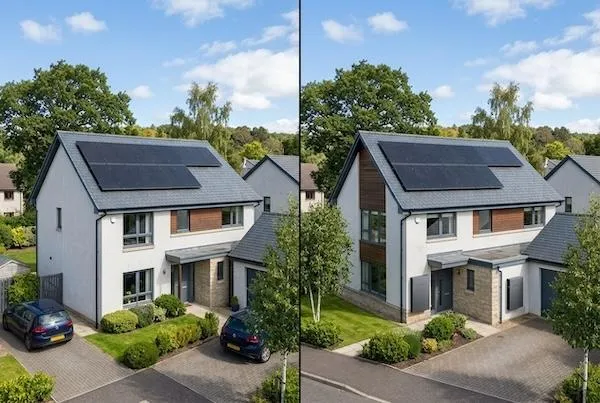
Solar Panels Only vs Solar + Battery Storage: Which Is Better for Glasgow Homes?
If you’re exploring solar energy in Glasgow, one of the most important decisions you’ll face is whether to install solar panels alone or pair them with a home battery storage system. Both options have merit, but the best choice depends on your energy goals, budget, and lifestyle.
In this guide, we’ll compare solar panels only vs solar + battery storage for Glasgow homeowners, covering costs, savings, energy independence, and real-world scenarios to help you decide.
Solar Panels Only: How It Works
A standalone solar PV system generates electricity during daylight hours. Any energy you don’t use immediately is exported back to the National Grid via the Smart Export Guarantee (SEG), earning you a small payment (typically 4–6p per kWh).
Advantages of Solar Panels Only
Lower upfront cost: £6,000–£9,000 for a typical 4 kW system
Faster payback: 8–12 years depending on usage
Immediate savings: reduce grid consumption by 30–50% during the day
Proven technology: 30-year panel warranties, minimal maintenance
SEG income: monetize surplus generation
Limitations
No energy storage: surplus energy is exported at low rates
No evening use of solar: you’ll draw from the grid after dark (20–30p/kWh)
No backup: no power during outages
Lower self-consumption: typically 30–40% of generation is used in-home
Solar + Battery Storage: How It Works
Adding a home battery (e.g., Tesla Powerwall 3, Hanchu ESS, Sonnen) stores surplus solar energy during the day for use in the evening and night. You can also charge the battery from the grid during off-peak hours if you have a time-of-use tariff.
Advantages of Solar + Battery
Higher self-consumption: 70–90% of your solar energy stays in-home
Evening energy independence: power lights, heating, appliances after sunset
Grid backup: critical loads stay online during outages (if system is configured)
Maximized savings: avoid peak-rate grid electricity (20–30p/kWh)
Future-proof: ready for EV charging, heat pump integration
SEG earnings: still export surplus after battery is full
Limitations
Higher upfront cost: add £5,000–£9,000 for a 10–13.5 kWh battery
Longer payback: 12–16 years depending on tariff and usage
More complex: inverter, BMS, installation requires expertise
Space: batteries are typically garage- or utility-room mounted
Cost Comparison: Glasgow 2026
System ConfigurationUpfront Cost (After VAT Relief)Annual SavingsPayback Period4 kW Solar Only£6,000–£9,000£500–£7508–12 years4 kW Solar + 10 kWh Battery£11,000–£17,000£900–£1,40012–16 years
Savings assume 3,500 kWh annual consumption, 30% self-use (solar only) vs 75% self-use (solar + battery), and 5p/kWh SEG rate.
Real-World Scenarios: Which Is Right for You?
Scenario 1: Daytime Energy Users → Solar Only
Profile: Home office worker, retired couple, or household where most energy is used 9 AM – 5 PM (dishwasher, washing machine, cooking).
Recommendation: Solar panels only. You’ll self-consume 50–60% of generation naturally, maximizing savings without battery cost.
Example: A Bearsden couple with a 4 kW system saves £650/year, achieving a 9-year payback.
Scenario 2: Evening & Night Users → Solar + Battery
Profile: Family where everyone is out during the day; high evening consumption (cooking, TV, lighting, heating); EV charging overnight.
Recommendation: Solar + battery storage. Store daytime generation for evening use, avoid peak-rate grid electricity.
Example: A Newton Mearns family with 4 kW solar + 13.5 kWh Tesla Powerwall saves £1,200/year, with a 13-year payback.
Scenario 3: Grid Reliability Concerns → Solar + Battery with Backup
Profile: Rural Glasgow outskirts; medical equipment in-home; or simply want peace of mind during storms.
Recommendation: Solar + battery with backup capability (e.g., Tesla Powerwall 3 with Gateway 3, or Hanchu ESS).
Benefit: Critical loads (fridge, heating controls, lighting, medical devices) stay powered during outages.
Scenario 4: Budget-Conscious, Future Flexibility → Solar Only (Battery-Ready)
Profile: Want solar now but can’t afford battery; open to adding storage in 3–5 years.
Recommendation: Install a hybrid inverter (e.g., GivEnergy, SolarEdge, SMA) that supports battery retrofitting.
Cost: Minimal upfront premium (£200–£500); add battery later without replacing inverter.
Energy Independence: The Numbers
MetricSolar OnlySolar + BatterySelf-consumption30–40%70–90%Grid dependenceHigh (evenings/night)Low (most hours covered)Peak-rate avoidanceLimitedHighExport to grid60–70% of generation10–30% of generation
Should You Add a Battery Later?
Yes, if:
Your inverter is battery-ready (hybrid)
Electricity prices continue rising
You add an EV or heat pump
Battery prices drop 20–30% (expected by 2028)
Installation cost: Adding a battery later typically costs £5,500–£8,000, similar to installing it upfront if your system is already battery-compatible.
Financing Both Options
Solar Only
0% VAT on installation (saves £1,200–£1,800)
Finance available: £80–£120/month over 10 years
ROI: break-even at year 8–12; 25+ years of profit
Solar + Battery
0% VAT on battery + installation (saves £2,200–£3,400)
Finance available: £140–£220/month over 10 years
ROI: break-even at year 12–16; long-term energy security
Our Recommendation for Glasgow Homeowners
Start with solar panels only if:
You use energy primarily during the day
Budget is tight but you want to start saving now
You’re comfortable with a hybrid inverter for future battery addition
Choose solar + battery if:
You use most energy in evenings/nights
You want maximum grid independence
You plan to add an EV or heat pump
You value backup power during outages
Frequently Asked Questions
1. Can I add a battery to my existing solar system?
Yes, as long as your inverter is battery-compatible (hybrid or AC-coupled). If you have an older string inverter, you may need an AC battery (e.g., Tesla Powerwall 3) or inverter upgrade. Solar Installers Glasgow can assess your system and recommend the best retrofit solution.
2. How long does a home battery last?
Most lithium-ion batteries are warrantied for 10 years or 4,000–6,000 cycles. Real-world lifespan is typically 12–15 years. After warranty, capacity may degrade to 70–80%, but the battery remains functional.
3. Will a battery save me more money than the SEG?
If you consume most energy in the evening, yes. A battery avoids 20–30p/kWh peak-rate grid electricity, while the SEG pays only 4–6p/kWh for exports. The financial benefit depends on your usage profile—contact us for a personalized savings estimate.
4. Do batteries work during power cuts?
Only if configured with backup capability (e.g., Tesla Powerwall with Gateway, or Hanchu ESS with EPS). Standard systems disconnect during outages for safety. Discuss backup requirements during your free survey.
Get Expert Advice: Free Solar Survey & Quote
Not sure whether to add battery storage? Solar Installers Glasgow offers a free, no-obligation site survey to assess your energy usage, roof, and budget. We’ll model both scenarios—solar only and solar + battery—so you can make an informed decision.
👉 Request Your Free Solar Survey and discover the best system for your Glasgow home.
We’re MCS-certified, HIES-protected, and trusted by hundreds of Glasgow homeowners. Finance options available from £80/month.
📞 Call us today or visit solarinstallersglasgow.com to start your solar journey.
Related: Glasgow Home Battery Storage Installation: Tesla Powerwall vs Hanchu ESS—Costs & Benefits Compared
